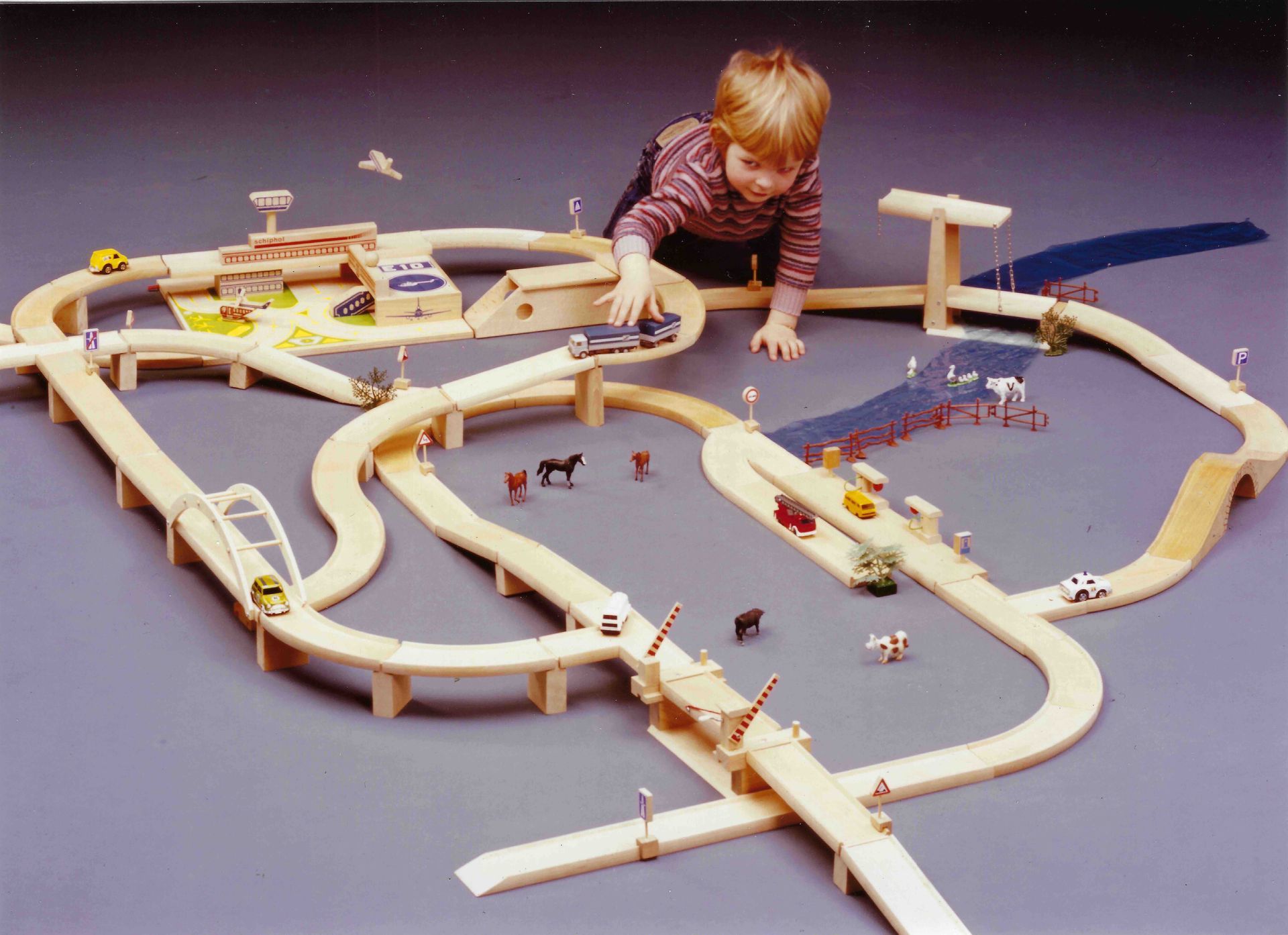
(bron: familie-archief Sliedrecht)
E10 Highway systeem
The crimp/hook system
How do you create a connection between two wooden road sections that children can assemble and disassemble without tools, that is sufficiently sturdy, and does not conflict with patents or intellectual property rights?
Jaap de Jong, in-house designer at Sliedrecht BV, and Gijsbert Sliedrecht have succeeded in providing the end of wooden road sections with a raised edge, known in engineering as a crimp. The connection consists of a raised edge from the underside (the bottom hook) and a raised edge from the top side (the top hook). With sufficient thickness of the road section, the risk of breakage is small, but some chipping cannot be prevented. The connection is strong in the longitudinal direction but slides apart easily in the transverse direction.
This unique crimp/hook system was applied to the first and second editions of the E10 Road System. Other brands, such as Brio, opted for a system with a hook and an eye.
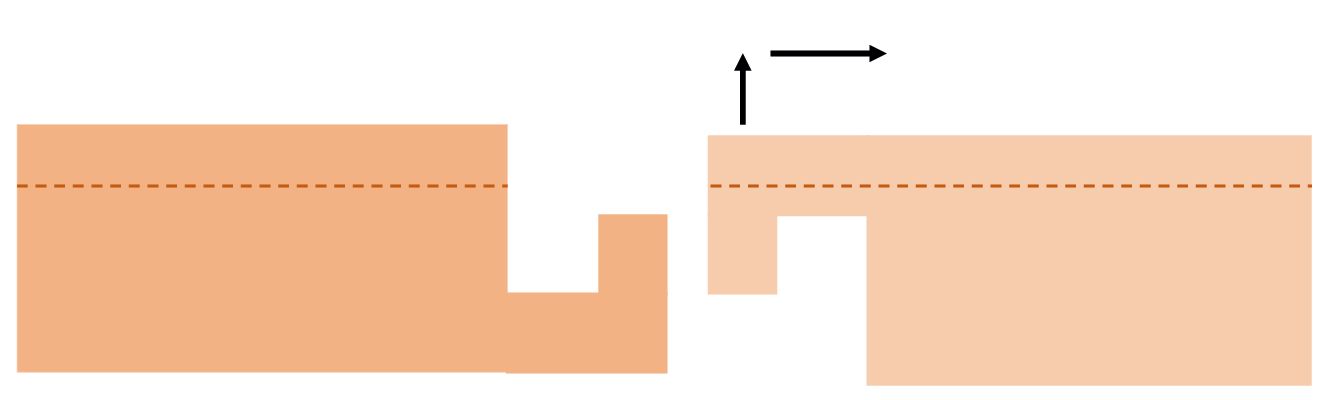
onthaakte verbinding
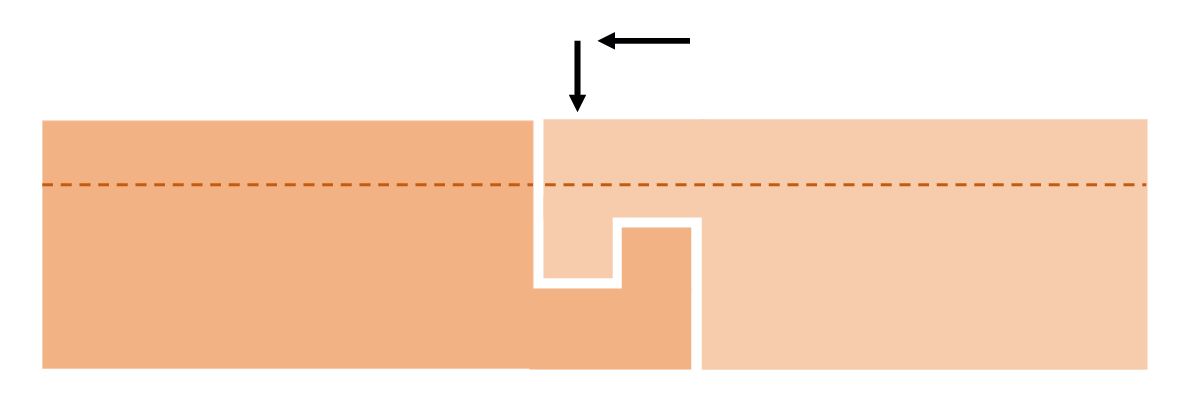
gehaakte verbinding
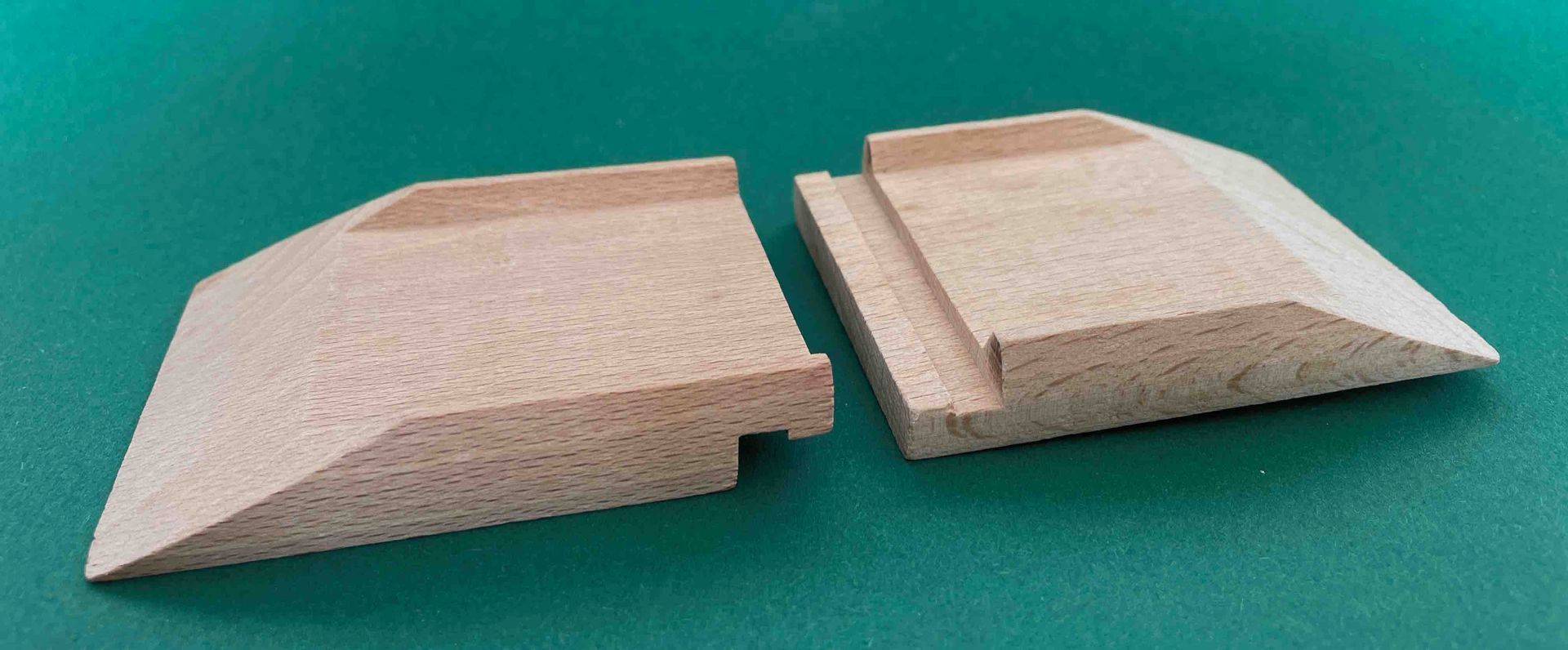
op- en afrijstrook met felsnaad
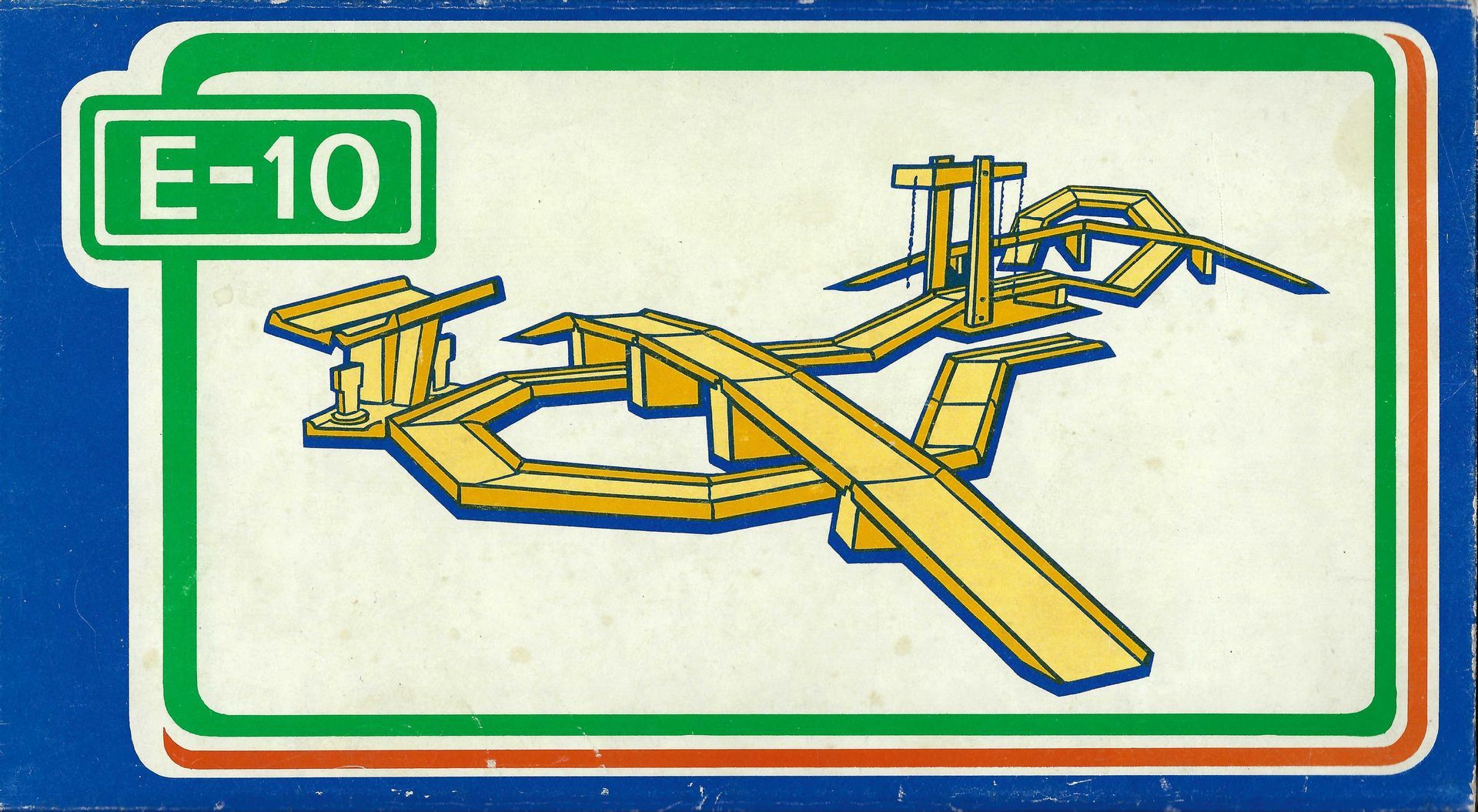
deksel eerste editie
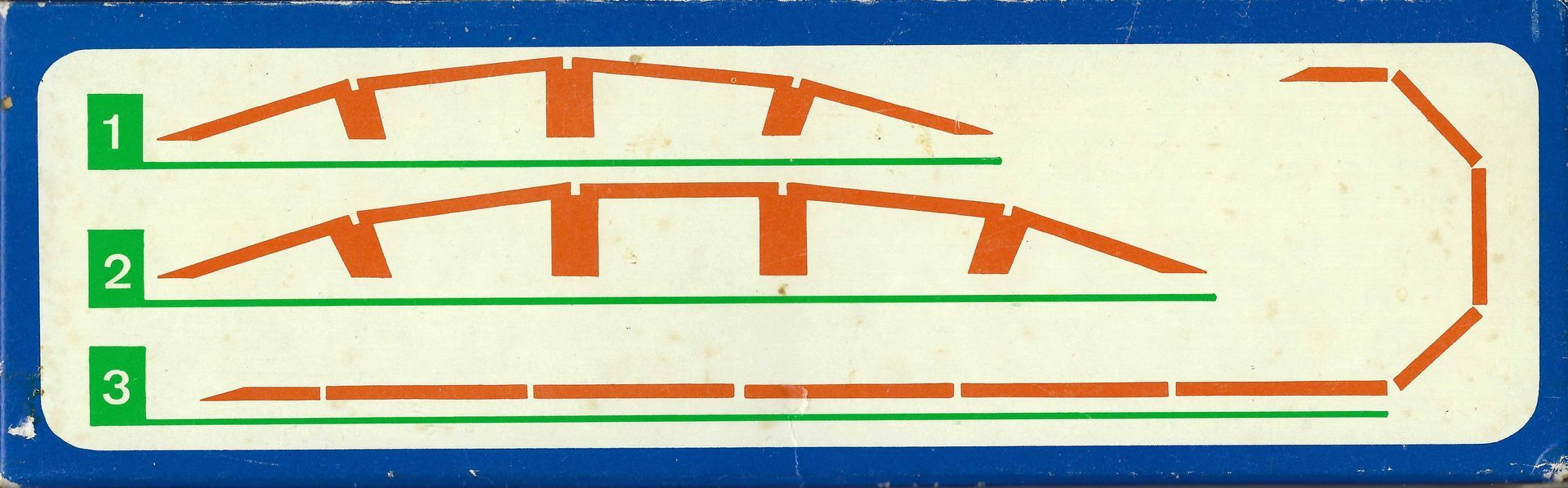
voorkant eerste editie
The first edition
In late 1971, early 1972, Sliedrecht BV released the first five boxes of the E10 Road System. Simple screen-printed boxes featuring beechwood lanes with only straight lanes. By sawing off a few lanes at an angle, a curve could still be created. Two more boxes quickly followed, containing a drawbridge and a petrol station respectively, both as construction kits.
Box 1 of this edition was supposed to contain a viaduct consisting of an on- and off-ramp, two lanes, and three pillars. However, it is unclear whether this box appeared in this form with these contents.
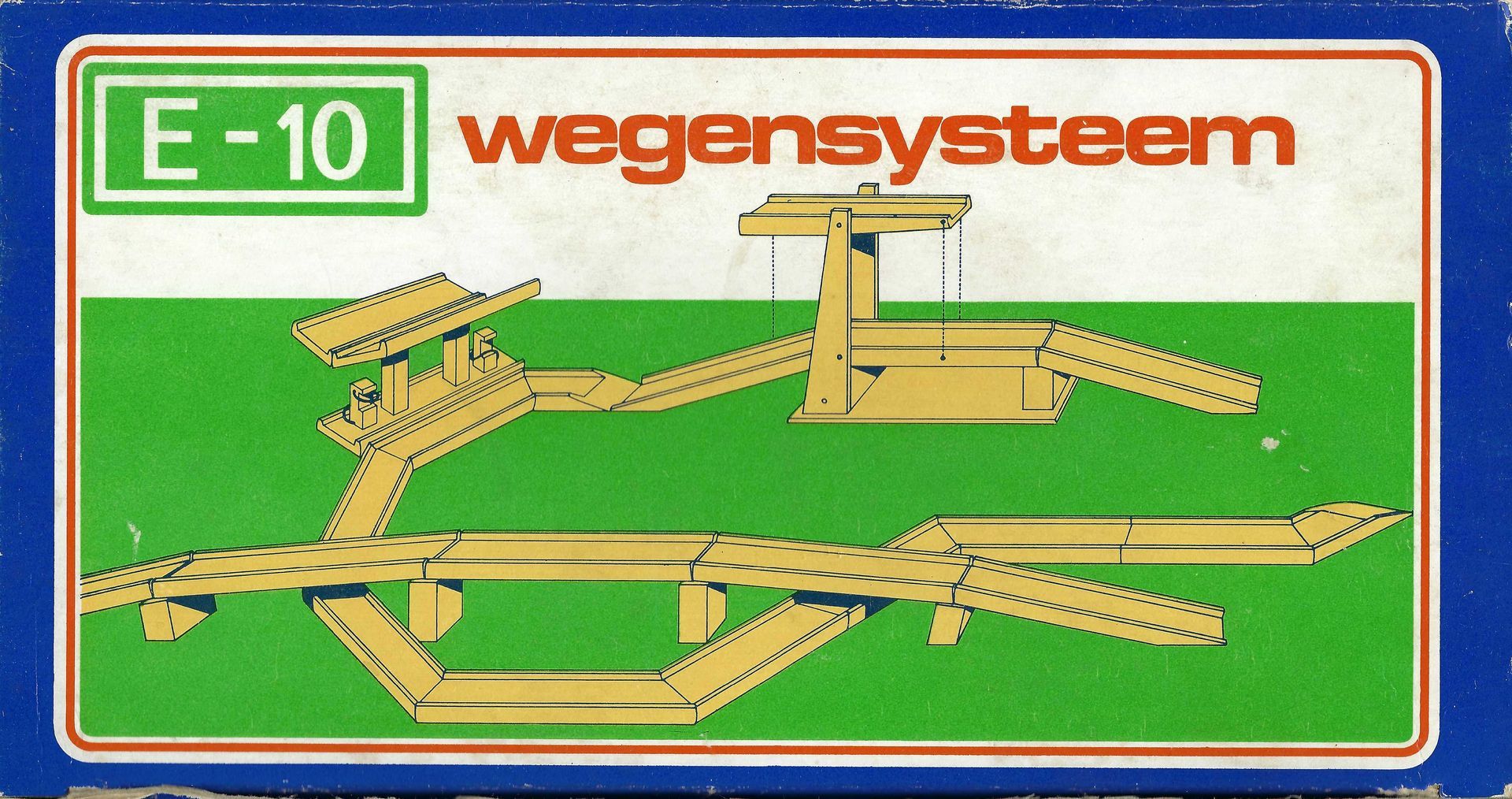
deksel tweede editie
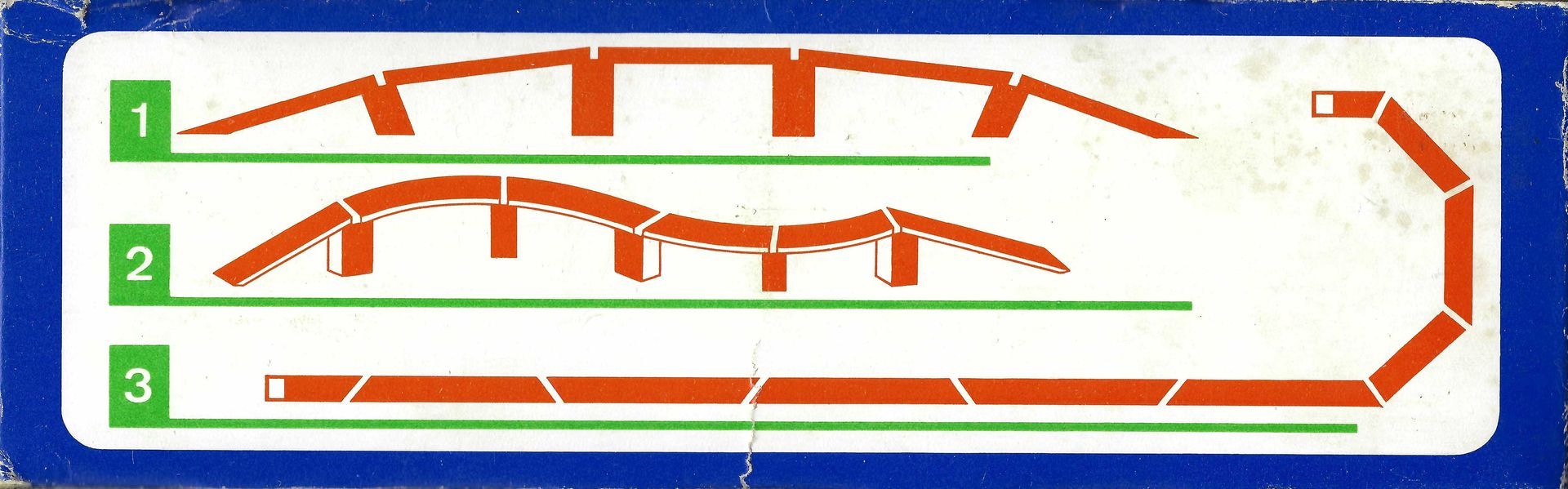
voorkant tweede editie
The second edition
In 1973, the contents of boxes 1 and 2 were revised. The old box 2, the viaduct with four pillars, became the new box 1. The boxes were given a green/white layout, creating a sort of horizon.
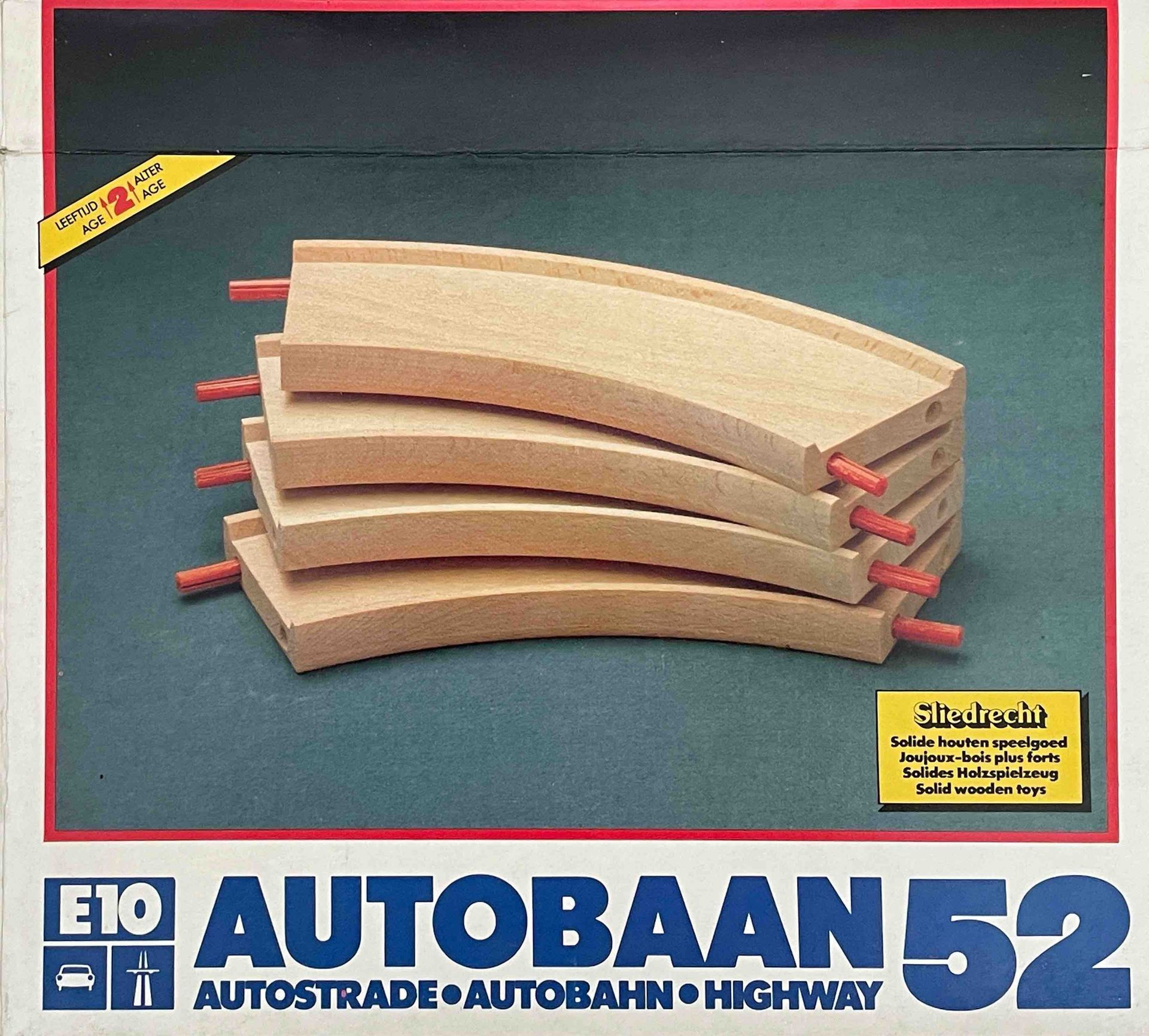
The new box 2 contains four curved lanes and two on- and off-ramps. All of this was supported by five identical pillars.
The experimental phase
The seam/hook system had its advantages and disadvantages. In any case, the chosen hook system made it impossible to simply rotate lanes 180 degrees and thus reroute them. Building bridges with continuous lanes also presented problems.
Two boxes indicate that Siedrecht BV experimented with a different connection method, namely a mortise and tenon joint. The wooden parts were fragile, could break off, and replacement was virtually impossible.
Also, in anticipation of the third edition, the bright color scheme of the boxes from the first and second editions was changed to brown with dark green.
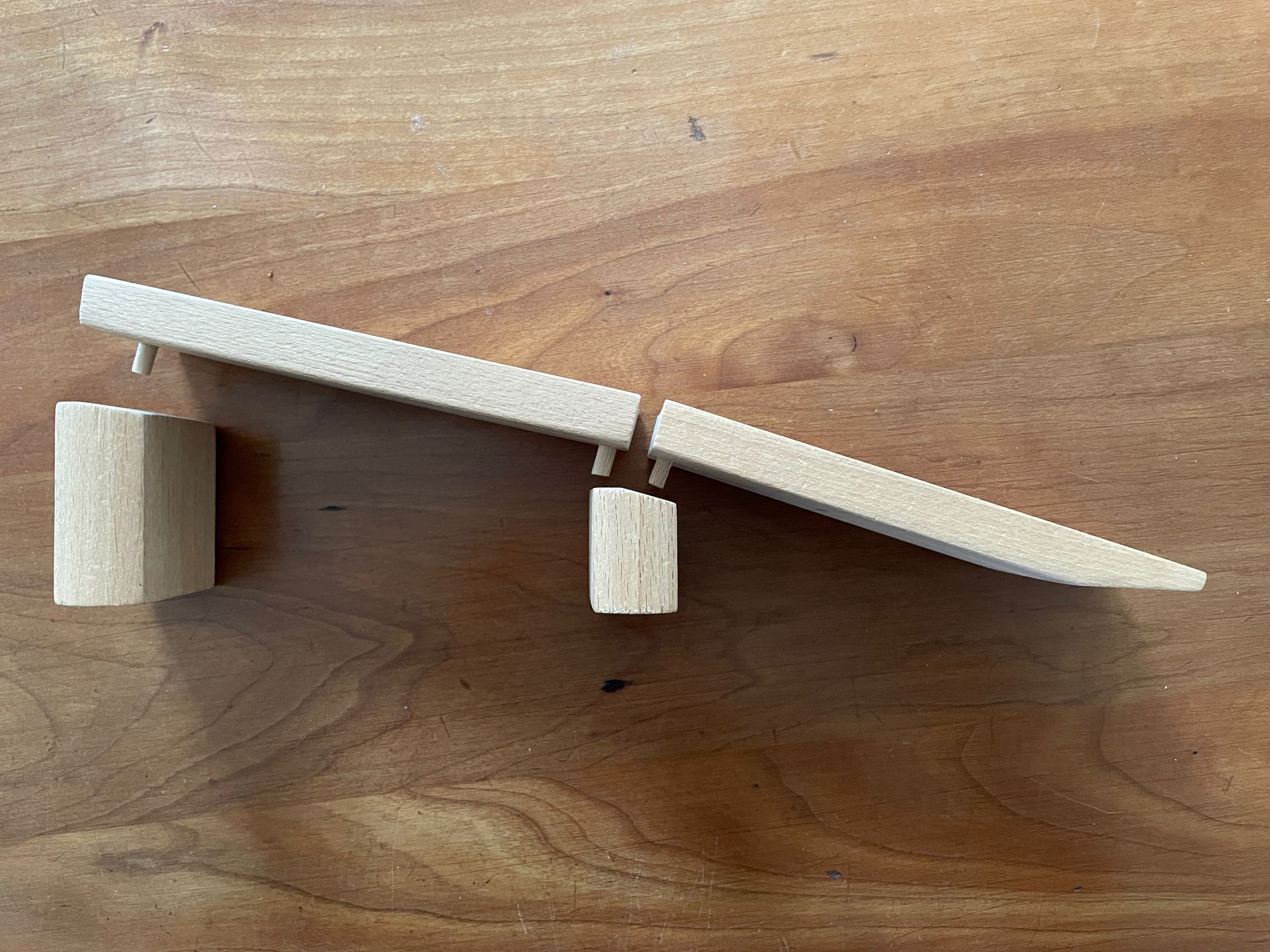
helling met pen/gat-syteem
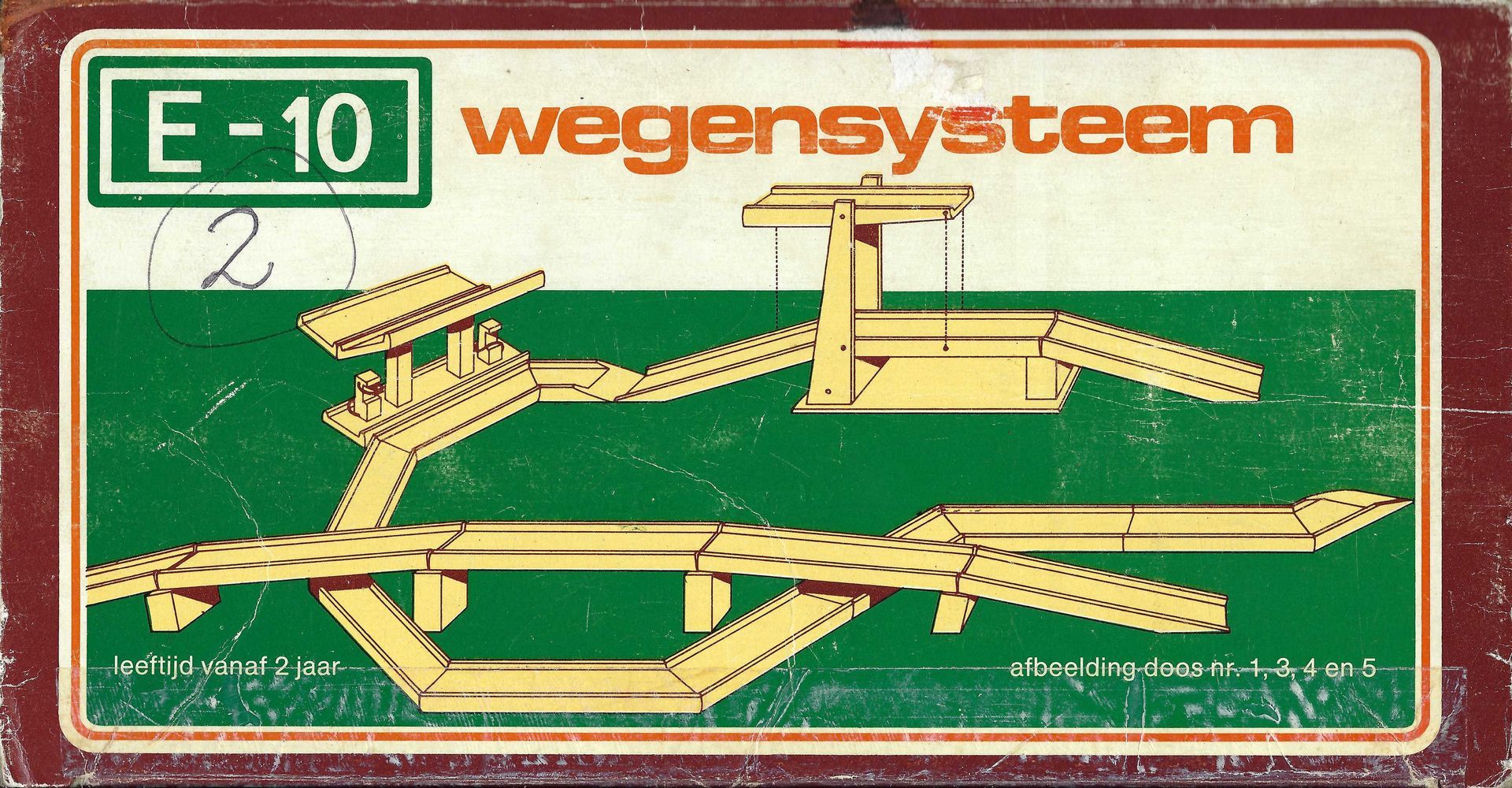
een bruin/donkergroene doos
The plug system
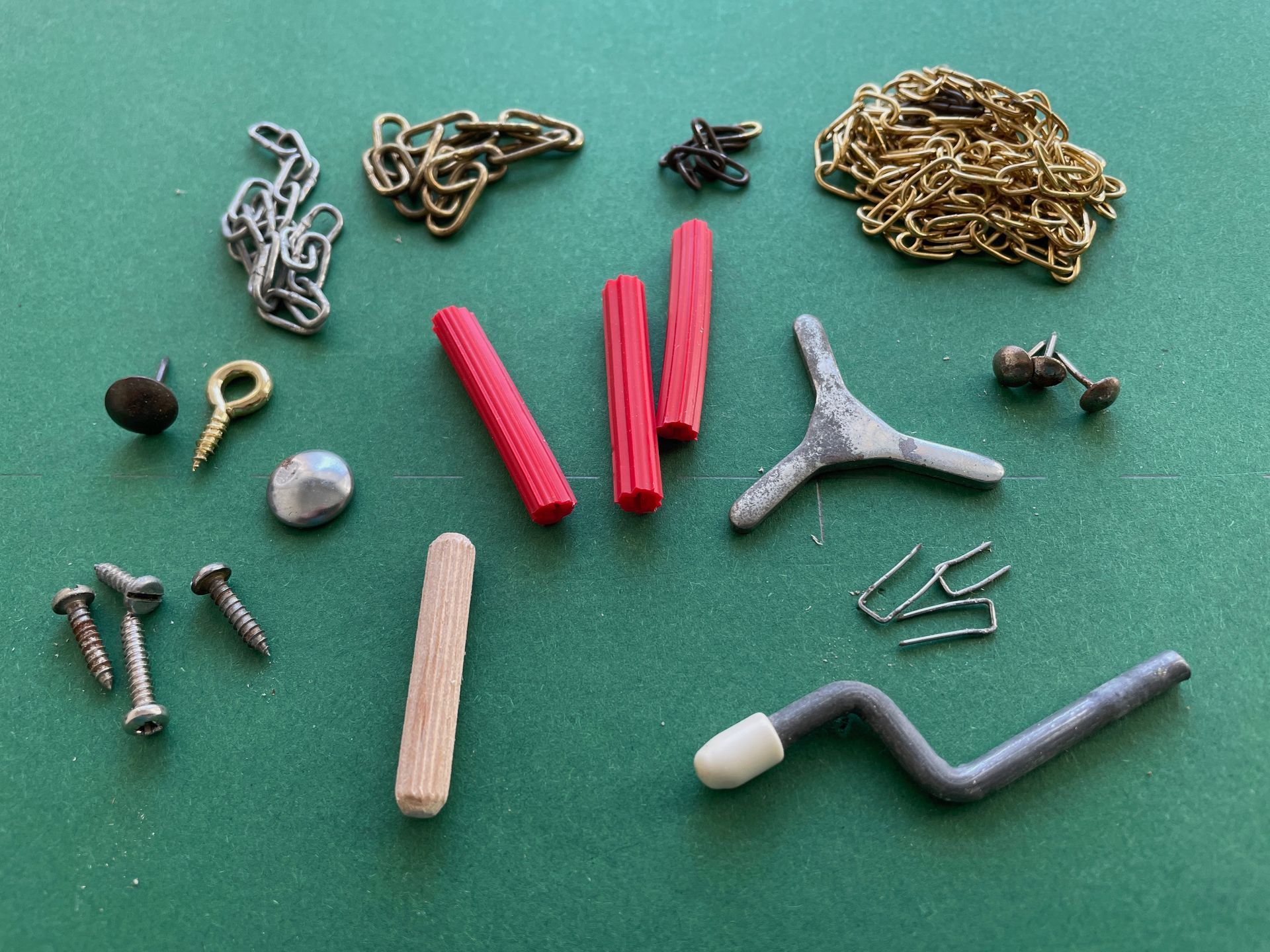
It is 1975. Sales of the Europoort Havensystem are disappointing, providing every reason to market the E10 Road System better and, above all, more completely. Connecting the lanes is simplified. Two 6.0 mm holes are drilled symmetrically at the ends of each lane. A red plug is placed in the right hole. This plug is held in place with a staple. The left hole remains open. The advantage is that, for example, curves can be installed to the left or right without any problems.
This makes it possible to construct roads without limitations.
However, there are also two disadvantages. When transitioning from a slanted lane to a horizontal lane, the plug must be bent slightly, or rather, forced. New plugs do this smoothly, but older plugs dry out and become brittle under the influence of sunlight. This brittleness subsequently leads to splintering and breakage of the plug. It is precisely because of this staple that broken plugs are difficult to replace.
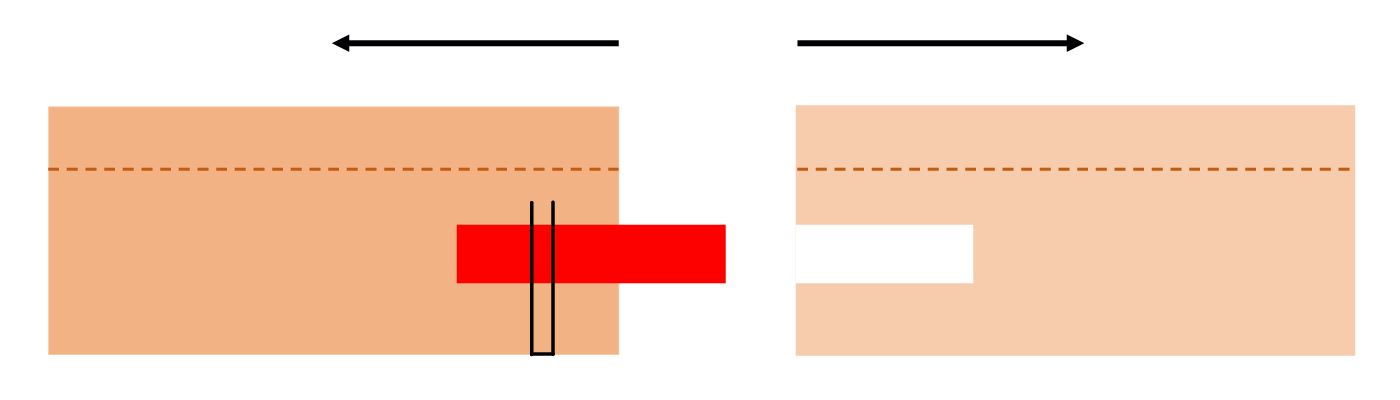
uitgeschoven plugverbinding
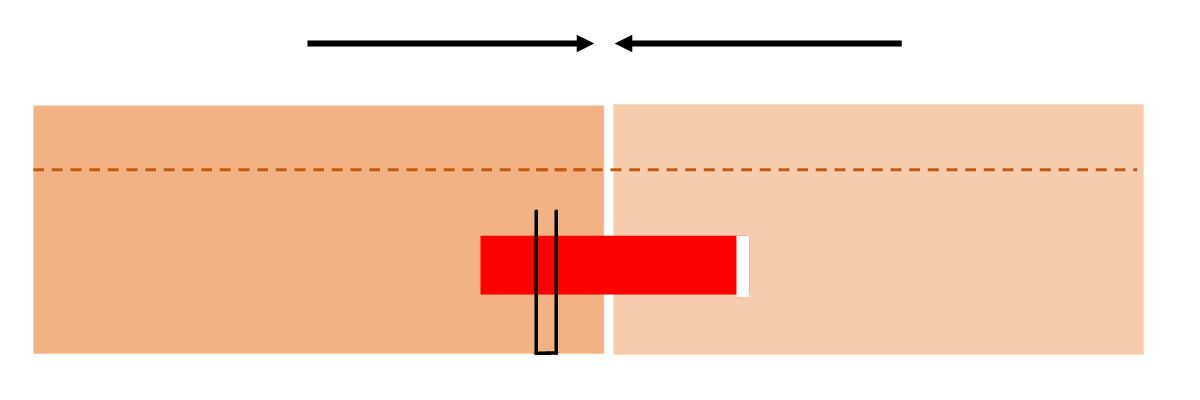
ingeschoven plugverbinding
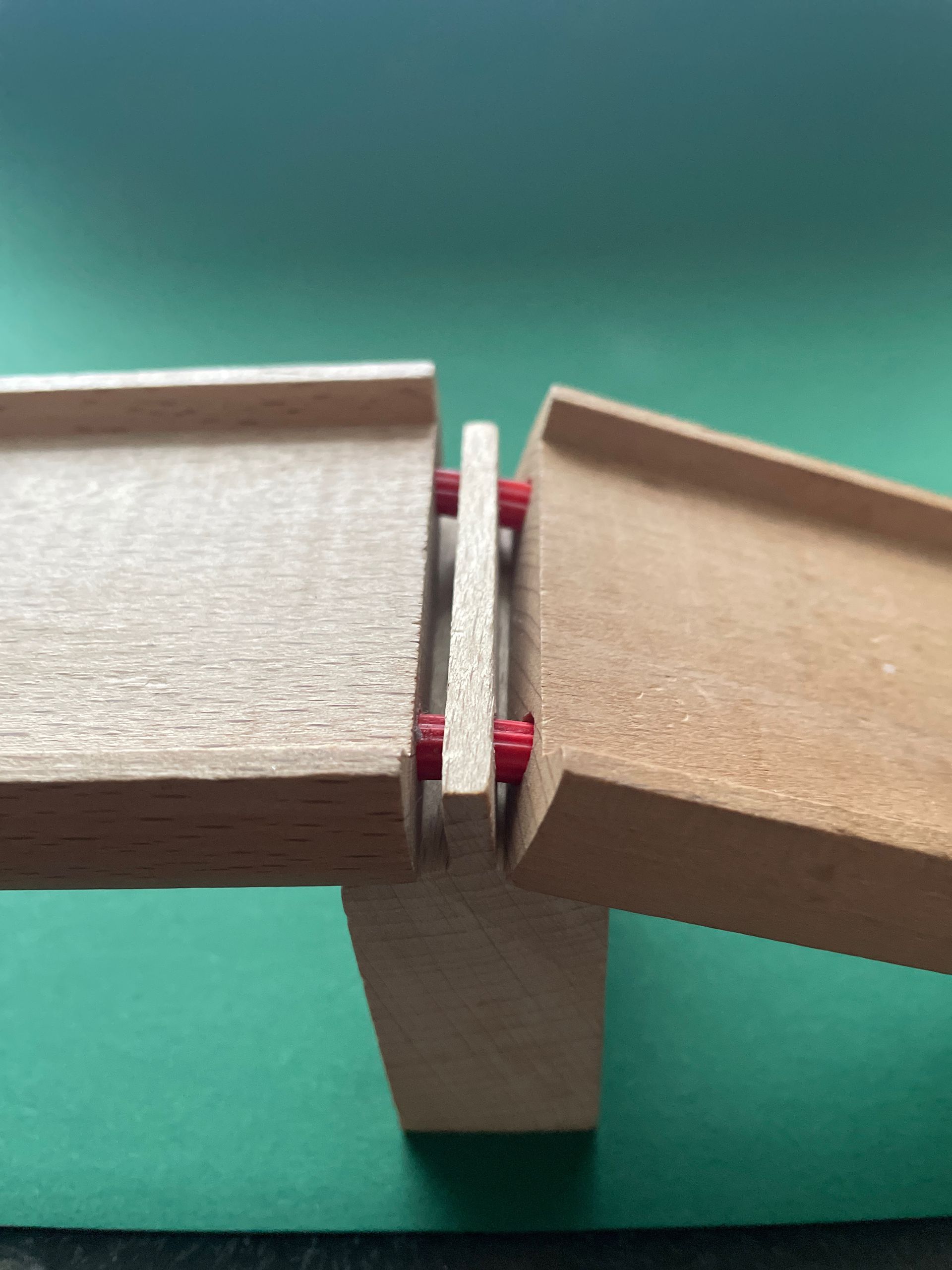
geforceerde plugverbinding (buiging)
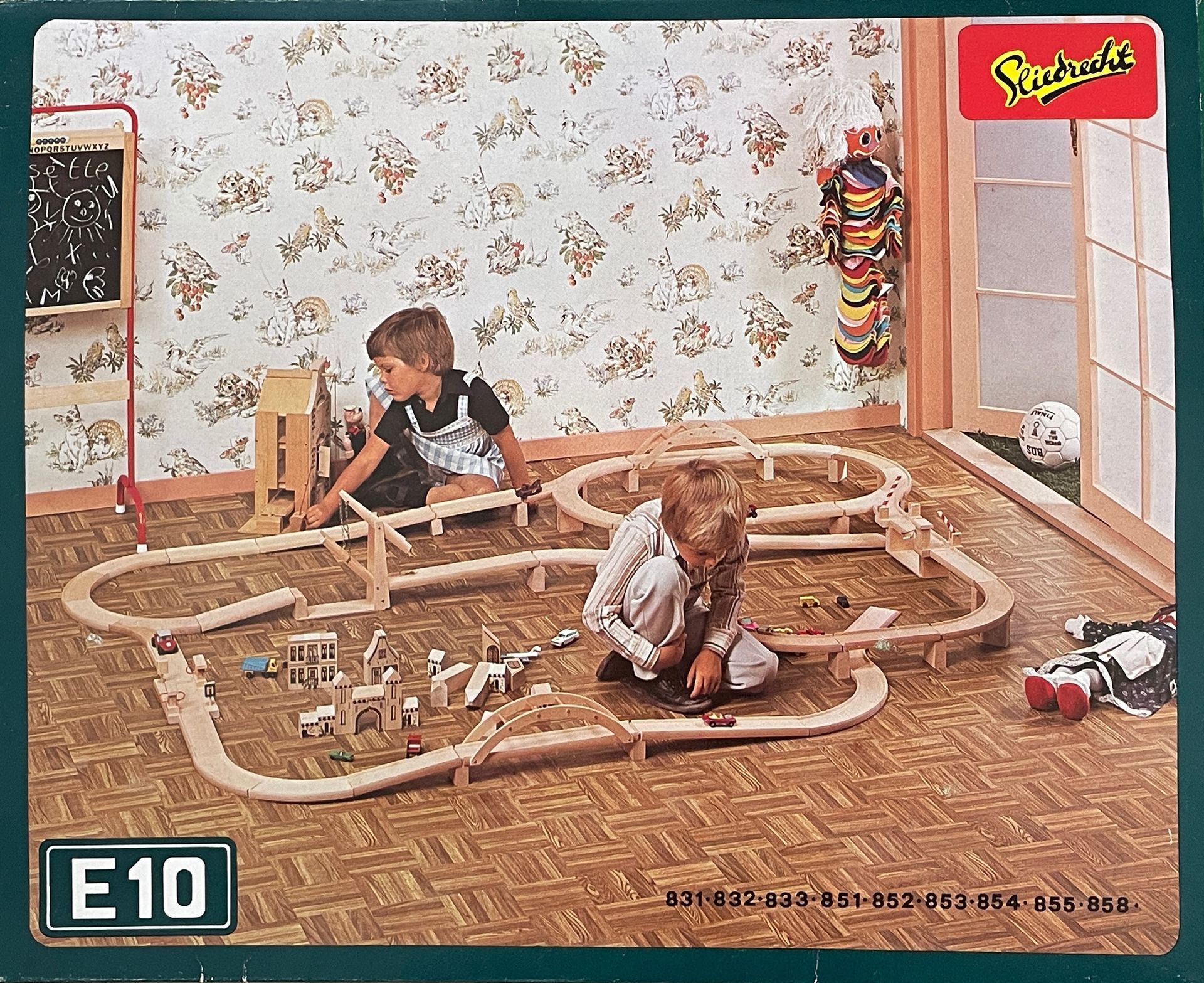
deksel derde editie
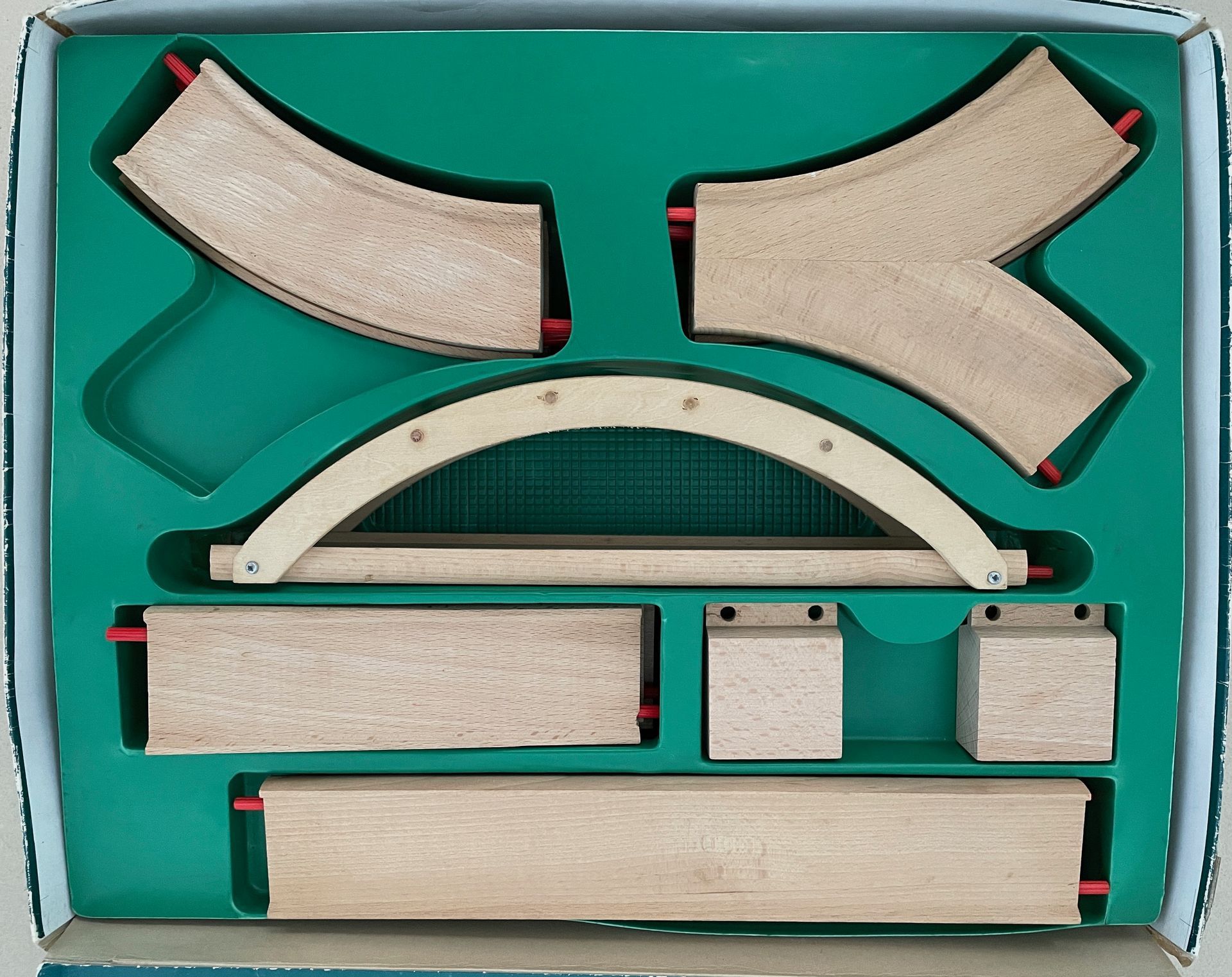
tray (met inhoud) derde editie
The third edition
There will be three base boxes and twelve add-on sets. A base box contains one of the three bridges, straight and curved lanes, on- and off-ramps, pillars, and, depending on the box, an exit or a Y-junction. The full range of lanes and accessories can be found in the various add-on sets, including a petrol station.
Transition pieces make it possible to connect the lanes with the crimp seam/hook system to the lanes with the red plug.
The boxes and add-on sets of the third edition show children playing in a real Sliedrecht room with a warehouse, a blackboard, and city blocks. This is somewhat misleading, however, as these are indeed from Sliedrecht BV but do not belong to the E-10 Road System. These boxes feature a red label with the word Sliedrecht painted in the top right corner. All parts are placed in a green tray.
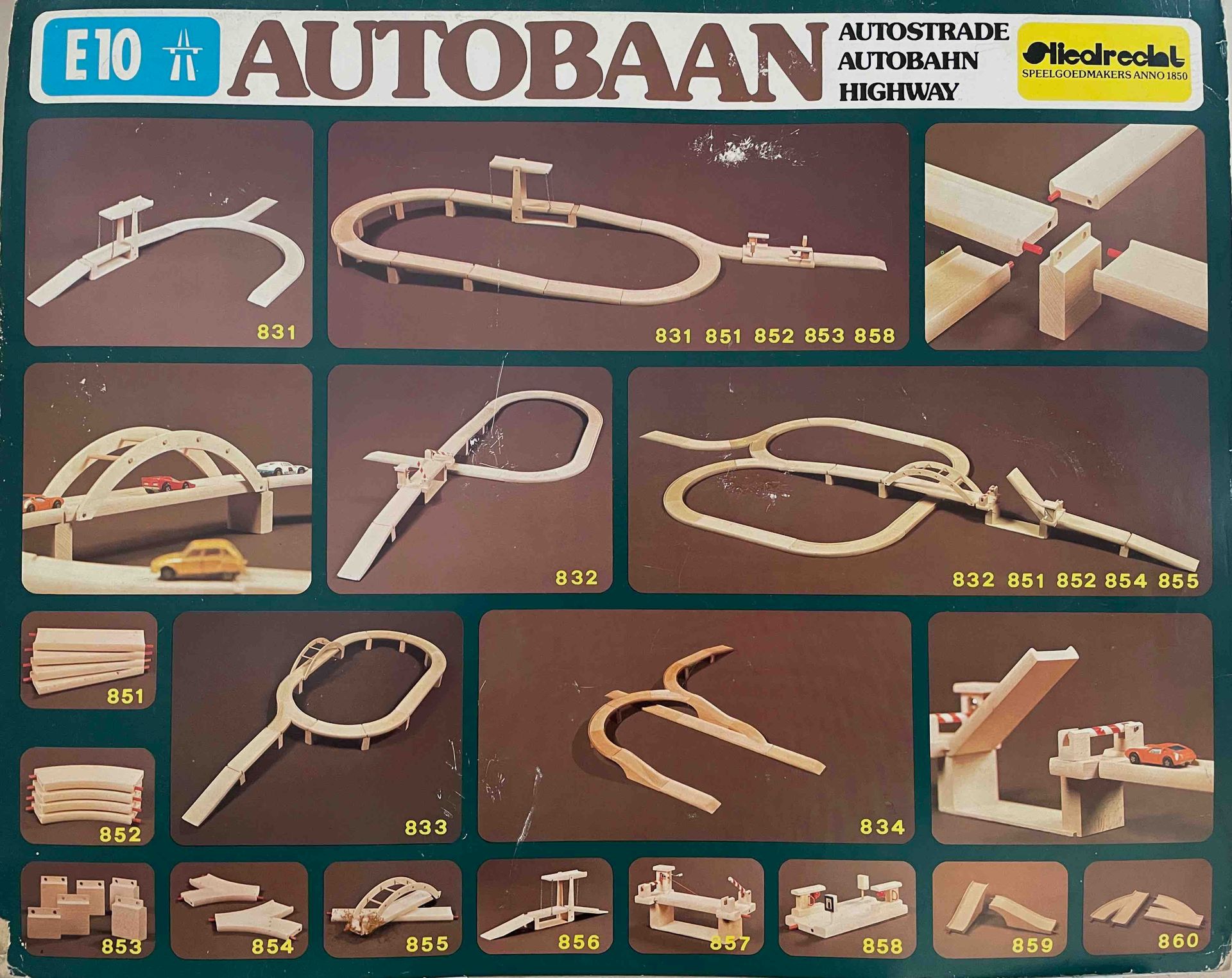
All Sliedrecht products for the domestic market are shown in the enclosed brochure. From this, it can be deduced that the four garages are no longer part of the E10 Highway system.
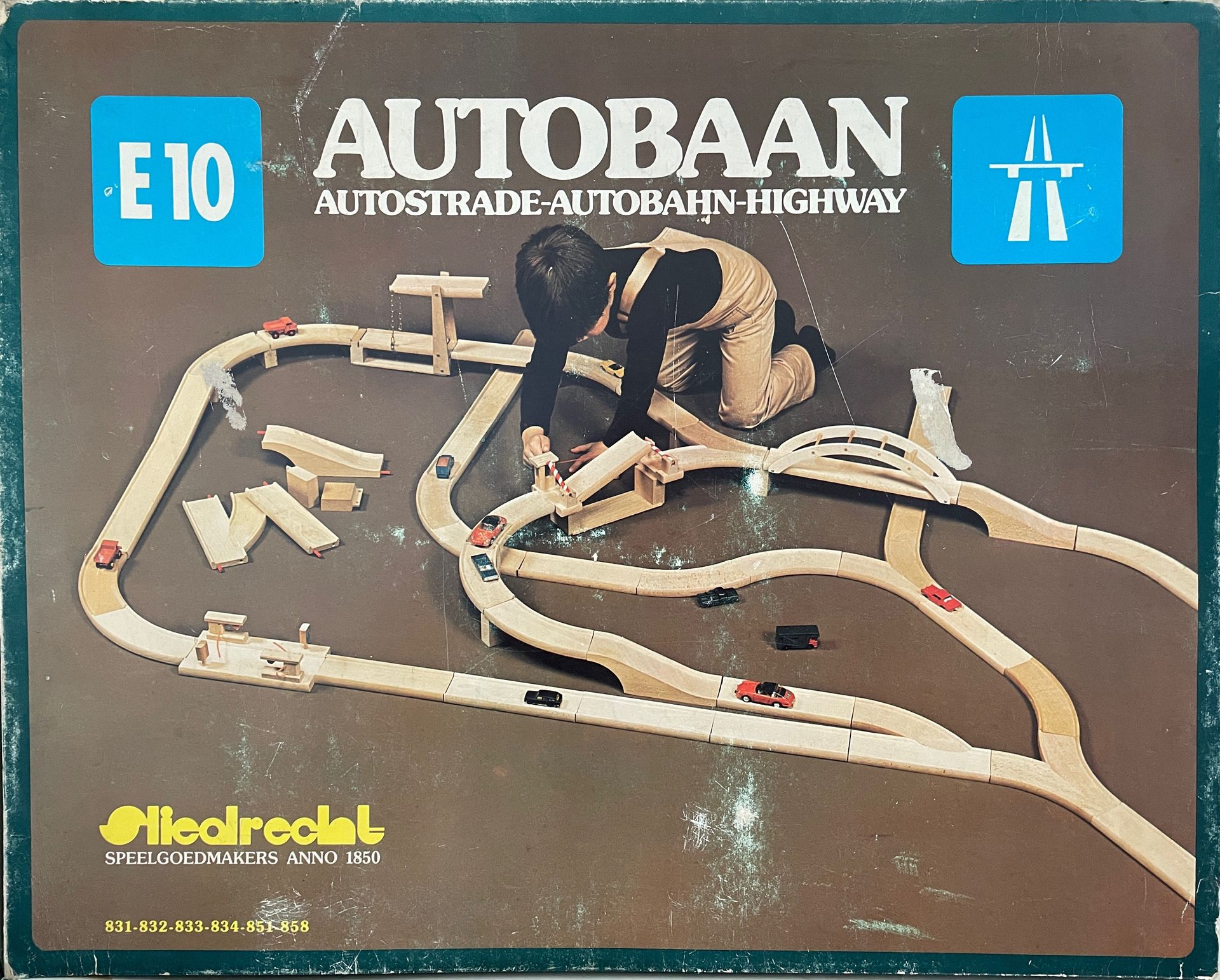
buitenkant deksel vierde editie
binnenkant deksel / catalogus
The fourth edition
In early 1980, there was a change in management at Sliedrecht BV. Following a certain tradition, the logo was changed. The word Sliedrecht appears in abstract yellow letters on a brown or black background.
The product range is expanded. A canal bridge is introduced. The bridge consists of two equal parts that together form an old Dutch arch. The bridge is also available as an add-on. New is the lane with a right turn. The inside of the lid serves as a catalog.
It is noticeable that more and more small differences are emerging within the fourth edition. The traffic bridge (number 832) is now available in four different lengths with two types of barriers. The bridge keeper's house with the winch is also subject to changes.
deksel basisdoos 33
voorkant aanvulset 52
The fifth edition
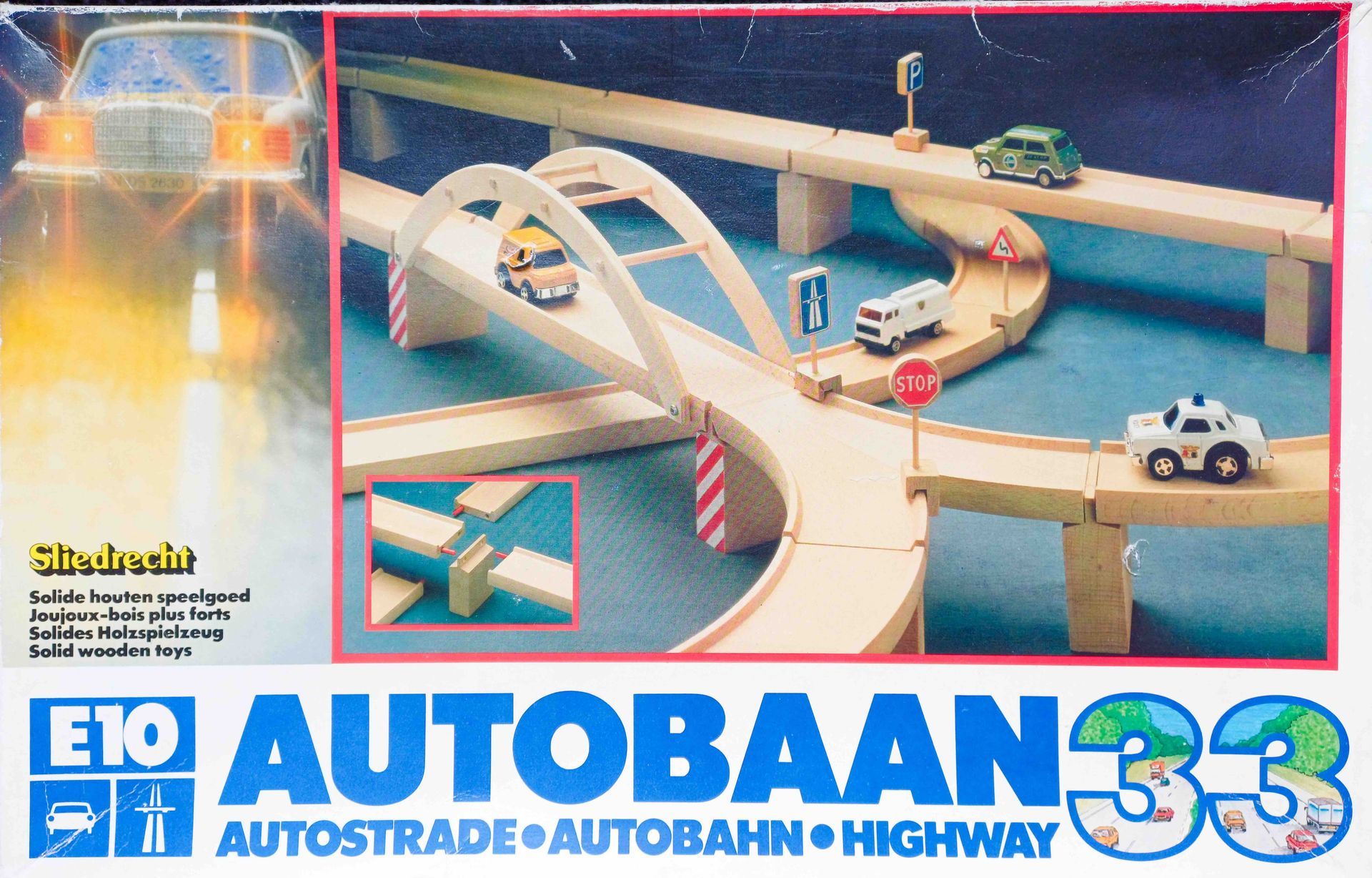
It is 1981. The newly appointed young management was confronted with a fire as well as disappointing sales results. The E10 Road System receives contemporary, glossy, more complete boxes. Thus, all base boxes receive traffic signs, small wooden cars, and sticker sheets to spruce up the bare beech wood. The deadline is the Nuremberg Toy Fair of 1983. They succeed!
The base box with the drawbridge is discontinued. The new, somewhat smaller base boxes (now without a tray) are well-stocked. The number of add-on sets grows to sixteen. One of these is the drawbridge. In addition, there is an intersection, a T-junction, a tunnel, and an add-on set with extra-high pillars. Completely new is Schiphol Airport, which can be connected to the E10 highway system using red plugs.
.
Want to see and know more?
More information about the E10 Road System can be found under:
* the
blue button below. This concerns the full story regarding the development of the E10 Road System from 1971 through 1984;
* the
black
button below. This concerns the complete overview of models and parts of the E10 Highway system as well as the Europoort Port System.
Under the uncolored button Boxes and leaflets, you will find a visual overview of all known boxes, refill sets, and other packaging with their leaflets
Seeing, knowing, searching, and finding
A website is for viewing, browsing, reading, and discovering what is interesting or useful. To that end, this site features five pages, which can be found in the top navigation bar. Below, there are six buttons; a single mouse click downloads a Word file containing further details or specific information. This text was translated from Dutch to English using Google Translate, which may have resulted in errors or awkward phrasing. In total, there are 125 pages of content available for reading and printing. The text and images will be updated as long as the website remains active.